
Treatment
Wasp nest treatment: the process and after-care
A targeted treatment begins with identifying the insect, understanding the nest entrance and deciding whether action is needed.
One message and a technician confirms the price and a time to visit.
Before treatment: understand the problem
A few wasps visiting flowers, food or a water source do not necessarily mean there is a nest on your property. A repeated flight line into one hole is a more useful clue. Watch only from a distance, without standing in that flight path. Tell us where the activity is, whether wasps are entering occupied rooms, and whether anyone nearby has a known sting allergy. These details help us discuss the next step without asking you to investigate a roof space or disturb a colony.
Step 1: identify the insect and the risk
We first establish whether the activity is consistent with wasps, European hornets or bees. A photograph can help if it can be taken safely, but a close-up is not worth a sting. Our bee or wasp guide explains useful differences. A nest well away from people may be left alone. Treatment is a decision about risk and location, not simply the presence of an insect in the garden.
Step 2: agree the visit
We give one fixed price on the phone, with no call-out fee and a free revisit if the treated nest remains active. Explain if you suspect several nests or need a commercial visit so that the scope is clear before booking. We answer the phone 8am–9pm, 7 days a week, and treatments are carried out from sunrise to sunset. Read how our fixed pricing works. Before arrival, keep people and animals away from the entrance and leave the nest undisturbed. Do not plug the hole, spray it or try to reveal the nest.
Finding and treating the nest
Step 3: check the entrance and surroundings
At the property, the flight line helps identify the entrance being used. The visible hole may lead into a concealed void rather than directly to an exposed nest. We consider nearby doors, windows, paths and places used by children or animals before treatment. Tell us about any previous insecticide application and any changes in activity. Several openings can belong to one nest, so counting holes is not a reliable way to count colonies.
Step 4: apply a targeted professional product
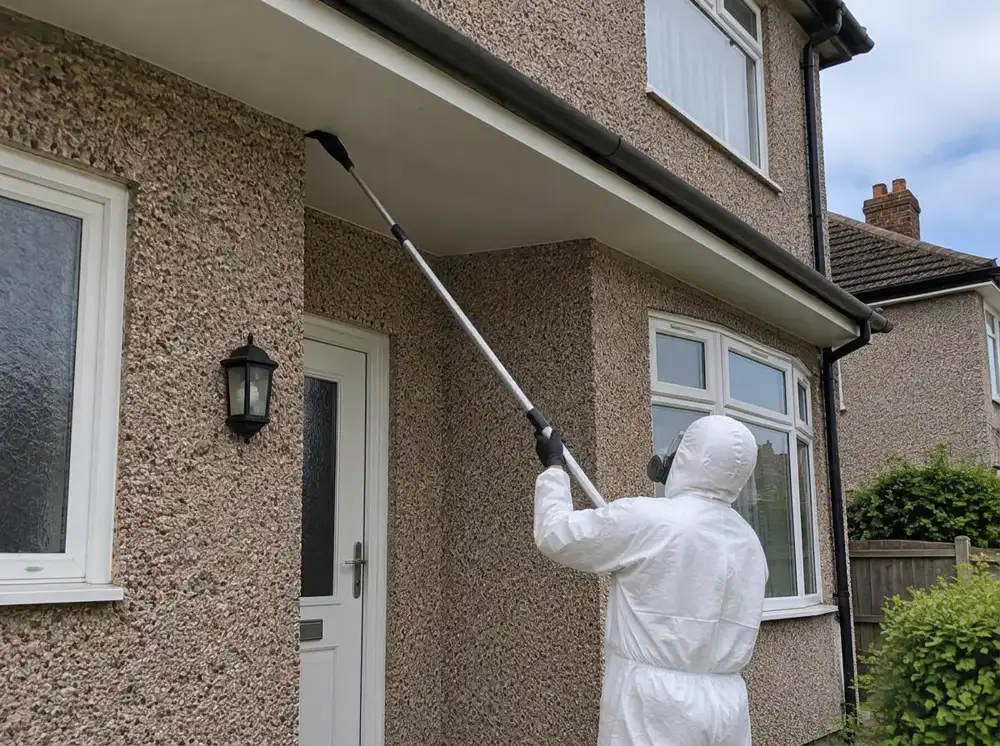
Nests are treated from the ground using a telescopic pole. Product selection and application depend on the nest position, insect and the authorised product label. In general terms, professional nest treatments use an insecticide formulation, such as a dust or liquid, directed at the relevant entrance or nest. This is not a blanket spray of the garden. We do not recommend putting household chemicals, fuel or water into a nest; these can create additional hazards without resolving the colony.
The aim is to control the active colony, not necessarily to remove the papery nest structure. Opening a ceiling or dismantling a roof is not something you should do to prepare for us. Our nest location pages explain why an entrance beneath roof tiles, in a wall or at ground level needs to be understood before anyone interferes with it.
Children, pets and the treatment area
Keep children and pets out of the treatment area during the visit and follow the specific instructions given afterwards. Let us know about ponds, aquariums, pet enclosures, outdoor toys and feeding bowls before work starts. Depending on the surroundings, items may need moving or protecting. Do not assume that a product suitable for professional nest treatment is harmless to every animal or suitable for unrestricted contact.
There is no single return-to-area interval that fits every product and property. We explain the precautions relevant to the application rather than offering a blanket promise. Keep children from watching close to the entrance and prevent dogs from sniffing or digging around it. If an animal may have contacted treatment material, seek veterinary advice and give the product details supplied at the visit.
After-care: leave the entrance open
Activity can continue after application, and disturbed wasps may behave defensively. Increased movement alone is not proof that treatment has succeeded or failed. Keep clear, avoid the flight line and observe only from a safe position. Do not block an active entrance: wasps in a building void may seek another route, potentially into the property. Do not add a shop-bought product over the treatment or attempt to clear the hole.
If the nest is still active after 48 hours, contact us to arrange the free revisit. Describe continuing entry and exit at the treated entrance, rather than isolated wasps feeding elsewhere in the garden. An old nest is not normally reused by a new colony, but another nest can be built nearby in a later season. Once inactivity is confirmed, suitable repairs to building gaps can be considered; see our prevention guide.
Hornet nests and situations we will not treat
European hornets are native insects and useful predators. We consider treatment where a nest poses a risk to people, rather than treating every sighting. Identification comes first: size alone is not enough. Read our European hornet guide for context, and keep away from any suspected nest while seeking advice.
We never treat bees. For a suspected honeybee swarm, contact a local beekeeper or a BBKA swarm collector; not all bee species or situations are suitable for collection. Suspected Asian hornets must be reported to the GB Non-Native Species Secretariat through the Asian Hornet Watch app. We do not treat Asian hornets. Do not approach, disturb or attempt to destroy a suspected nest. Identification and the appropriate reporting route take priority over booking ordinary wasp treatment.
Find advice for your property
Explore our wasp and hornet guides and nest location advice before disturbing an entrance. Our borough directory and area pages explain the coverage across Middlesex, including Ruislip. For advice about your own situation, call 020 8419 8769. Describe what you can see from a safe distance; there is no need to expose the nest to make an enquiry.
Frequently asked questions
Do I need to expose the nest first?
No. Leave the entrance and surrounding structure alone. Describe the flight line from a safe distance; opening a void can disturb the colony and increase the chance of stings.
Can children and pets stay nearby?
Keep them away from the treatment area and follow the product-specific precautions given at the visit. Tell us about pet enclosures, ponds and places children use before treatment begins.
Will you take the nest away?
Treatment targets the active colony. Physical removal is not normally necessary, and a concealed nest may remain in place. Do not open a wall or ceiling to remove it yourself.
What if wasps are still entering after treatment?
Keep clear and do not seal the entrance or add other products. If the treated nest remains active after 48 hours, contact us for a free revisit.
Do you treat bees or Asian hornets?
We never treat bees; ask local beekeepers or BBKA swarm collectors about honeybee swarms. Report suspected Asian hornets to GB NNSS through the Asian Hornet Watch app. We do not treat them.
Speak to a technician, not a call centre.
Fixed price on the phone. No call-out fee. Free revisit if the nest is still active.